
Edison City Directory Holdings
The confirmed Edison directory shelf is in the New Jersey State Library inventory, rather than in a claimed all-years online database. Its Edison entries are R.L. Polk volumes from 1964, 1966, and 1968. The inventory is a holdings guide, so it establishes where a volume is held and how it is stored, not that every page has been digitized or that each book covers every Edison street. Start with the printed scope line, then record the exact year and page before drawing a household conclusion.
| Collection | Years | Where Held | Access |
|---|---|---|---|
| R.L. Polk's Edison Township Directory | 1964 | New Jersey State Library | Book, Genealogy level 4 |
| R.L. Polk's Edison Township Directory | 1966 | New Jersey State Library | Book, Genealogy level 4 |
| R.L. Polk's Edison City Directory | 1968 | New Jersey State Library | Book, Genealogy level 4 |
| Edison local archive publications | 1954, 1963, 1957-2017 by collection | Edison Public Library digital archive | Open online collections |
The State Library holdings inventory labels ordinary copies as Book. In its terminology, Book copies are on the special Genealogy level 4; Rare Book material is locked and needs reference help; microfilm and microform use their own level-4 drawers. Confirm the current reading-room arrangement before traveling.
R.L. Polk Edison City Directory Years
The 1964 item is titled Polk's Edison Township Directory and its scope names Banhamton, Clara Barton, Edison, Menlo Park, Nixon, North Edison, Oak Tree, and Stelton. The 1966 Polk directory names Edison and Menlo Park. The 1968 item is listed as Polk's Edison City Directory. Those differences matter. They are evidence of the publisher's described territory, not a promise that a person, address, or street appears in every one of the three volumes.
Banhamton is particularly useful search vocabulary. The State Library inventory uses that spelling, while the 1963 civic material uses Bonhamtown. Keep both forms in a research note, along with local names such as Menlo Park and Oak Tree. A missed entry can reflect the book's coverage, spelling, or filing practice rather than a firm negative result.
Note: Copy the title page and the directory's own coverage note before treating an indexed name as Edison-wide evidence.
Accessing an Edison City Directory Shelf
A physical directory visit has a simple sequence: locate the listed volume, photograph or transcribe its title and scope page, use the name or street portion that actually exists, and retain the page number. The State Library guide distinguishes Book, Rare Book, microfilm, and fiche storage. That distinction is important because a catalog hit may require a different reader, drawer, or staff-assisted retrieval rather than an open online scan.
The Edison volumes are confirmed Book holdings. The surrounding guide says microform is kept on level 4, with the top four drawers for microfilm and other microform; Gale city and segment reels are in drawers 5 through 7, and fiche is in binders. That is access language, not a claim that the Edison Polk books themselves are on film. If a requested item is rare or not readily available, ask library staff about reference assistance rather than guessing from a catalog abbreviation.
Reading an Edison City Directory Page
No Edison directory page scan was captured in the research, so a sample entry cannot be invented. Treat a physical inspection as a record of what the particular volume prints. The useful inventory below is a checklist for notes, not a fictional transcription and not a claim that every Polk entry contains every field.
| Name as printed | Preserve initials, spelling, suffixes, and any cross-reference exactly as the page gives them. |
|---|---|
| Address or section | Record the street, number if printed, local section, and the directory page number. |
| Household wording | Note spouse, widow, boarder, or householder language only when the physical page actually shows it. |
| Work or organization detail | Capture an occupation, employer, club, or other printed affiliation as a dated clue, not current status. |
| Volume context | Save title, publisher, year, scope statement, abbreviation key, and whether a street-order section exists. |
- Criss-cross directory
- A companion arrangement that lists addresses or streets in order rather than beginning with a person's name.
- Householder index
- A name-oriented list focused on a household head or named resident; it may not represent every person at an address.
- Abbreviation key
- The volume's explanation of its shorthand. Photograph it first because identical letters can mean different things across publications.
Edison City Directories Before 1954
Older searches need a municipal-name crosswalk. Edison was Raritan Township until 1954, when the township, including Menlo Park, took the Edison Township name. A historical directory or land record may therefore live under Raritan Township or a settlement label instead of Edison. Use that old label in catalog and index searching, then preserve it in the citation so a later reader can retrace the path.
Nearby New Brunswick directories can supply earlier context, but they are not automatic Edison directories. The State Library notes that the 1901 volume includes Bonhamtown, Metuchen, Raritan River Road, and Bound Brook; the 1903 volume includes rural-delivery routes; the 1940 volume includes parts of Raritan, North Brunswick, and Franklin; 1946 and 1954 include parts of Raritan Township; and 1962 and 1963 include parts of Edison and North Brunswick Townships. Later New Brunswick editions may center on other places, so read each scope note before using an absence as evidence.
Edison City Directory Companions
The Edison Public Library digital archive adds a different, dated printed-name layer. Its collection signals include newspaper clippings from 1957 to 1979, meeting minutes from 1973 to 2017, Limelight newsletters from 1987 to 2005, early-1950s photographs, and the 1954 and 1963 Know Your Township publications. These are useful for public notices, civic references, captions, and local vocabulary, not a continuous household directory.
See the Edison digital collections source before using the archive view below.
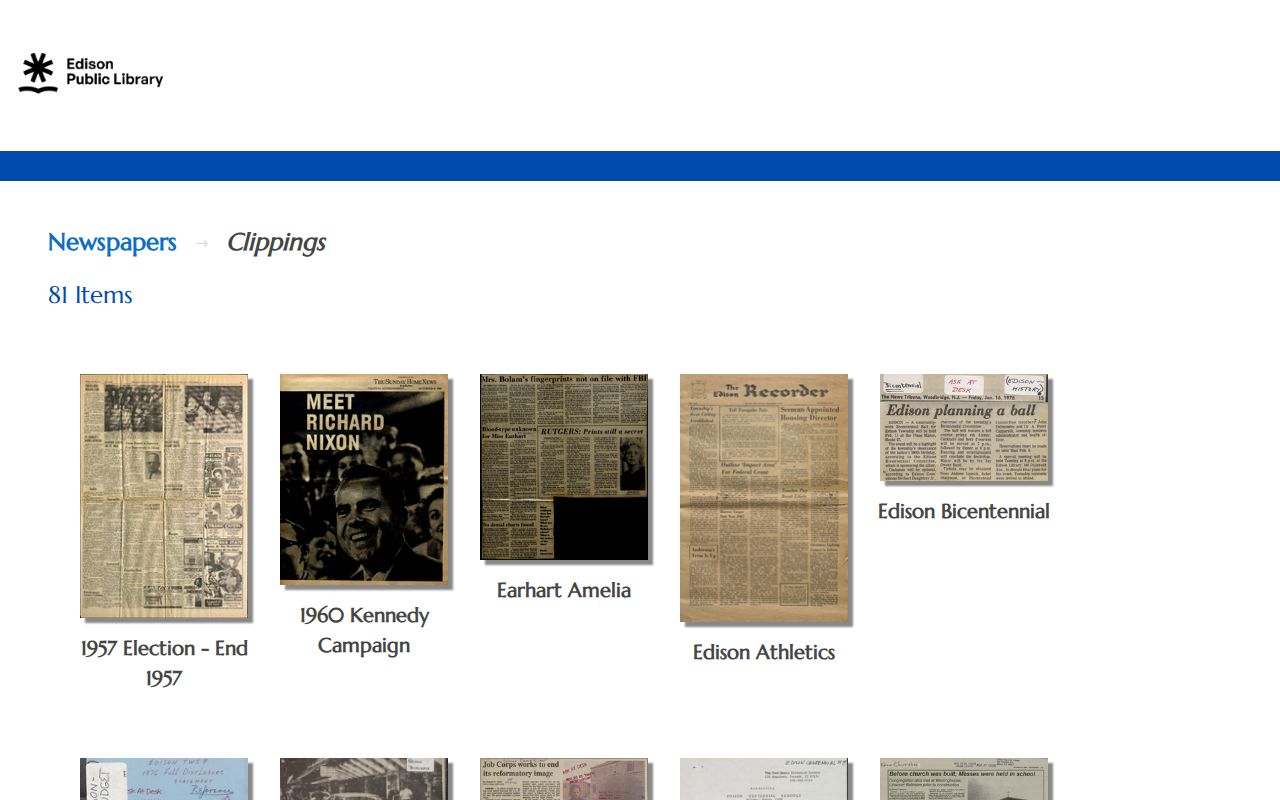
The archive tiles point to several kinds of local material, so cite the collection and date that produced a name or address clue. The 1963 civic list, for example, names Bonhamtown, Clara Barton, Menlo Park, Pumptown, and West Edison organizations, but it is a historical organization snapshot rather than a current roster.
Tracing Edison City Directory Households
A city directory lead becomes more useful when it is tested across time. Follow the same spelling and address through the confirmed Edison Polk years, then use a relevant New Brunswick volume only where its printed scope includes the place being researched. Pair directory years with federal schedules and New Jersey state census material from 1855 through 1915 when the date and jurisdiction fit. A later deed can verify a recorded transfer, but it should not be used to rename a listed household as an owner without evidence.
- Start with one stated directory year, then record the exact title, scope note, page, name spelling, and address wording.
- Check another confirmed Edison volume for a move, changed household wording, or a missing entry, noting that the scope may differ.
- Use the Raritan Township and local-section vocabulary when the time period predates 1954.
- Pair the dated household lead with an appropriate federal or New Jersey state census record, keeping jurisdiction boundaries in mind.
- Test a property lead in the County Clerk index or local archive, and label each source by what it actually proves.
For a later property trail, the Edison previous residents page uses the County Clerk's recorded-instrument chain rather than turning a directory listing into ownership proof. The stronger conclusion is usually a short one: directory-listed household in a named year, followed by the independent record that confirms the next link.
Edison Directory Leads and Probate
When a household disappears from a directory or a property changes hands, probate can explain an estate transition. Middlesex County probate routes include the County Surrogate, State Archives holdings, and FamilySearch browse images. State Archives material includes older surrogate books and records, while FamilySearch lists New Jersey, Middlesex County probate images for 1830 to 1921. An executor, heir, or estate description is still not proof of continuous residence, so keep the probate citation separate from the directory entry.
View the FamilySearch New Jersey collection listing before relying on its browse-images access.
The collection listing is a route to images, not a promise that each estate is name-indexed or that an image gives an address. It works best as a companion to a dated Edison directory citation and the County Surrogate or Archives record trail.
Edison City Directory Geography
Menlo Park has an unusually deep historical footprint because Thomas Edison lived and worked there from 1876 to 1886 before moving to West Orange. That history helps explain why Menlo Park appears in directory scope, photographs, publications, and local-history references. It does not convert an industrial-history source into a household roll. Keep the source type clear: a directory lists a published name or address, a clipping preserves a dated mention, and a deed records a legal instrument.
The Genealogical Society of New Jersey's Middlesex locality guide reports no substantial record loss, which supports a wider search when one volume comes up empty. Shift among the State Library shelf, Edison digital archive, County Clerk public-records room, State Archives, FamilySearch, and local historical repositories rather than filling an evidence gap with a guess.
That preservation finding does not mean every Edison record is digitized or indexed. It does support changing repositories before drawing a negative conclusion. A missing Polk entry may call for the correct Raritan Township label, a relevant New Brunswick scope note, an archive clipping, or a deed and probate search instead of a claim that the household never appeared in local records.