
Edison Previous Residents Sources by Era
Edison previous-residents research moves across sources because no one record set captures an Edison address through every era. A modern Edison assessment identifies the parcel and a recorded deed supplies a legal transaction. Historical Edison directories and censuses can provide a dated household clue. Probate can identify an estate link. Each row below names the type of evidence it supplies, so an assessed owner, recorded grantee, directory-listed household, and estate party do not get blended into one untested Edison claim.
| Source | Years It Covers | Where Held | What It Shows |
|---|---|---|---|
| Edison County Clerk modern browser | Deeds 1929-present per current page | Middlesex Official Records | Recorded parties, instruments, book and page trail |
| Edison county digitization announcement | Public deeds to 1923 per 2022 announcement | County online or counter route | Older-deed digitization claim to reconcile |
| Edison State Archives deed records | Deeds 1784-1901; indexes 1784-1922 | New Jersey State Archives | Older grantor-grantee and book-page path |
| R.L. Polk Edison directories | 1964, 1966, 1968 | New Jersey State Library | Dated printed household and address leads |
| Edison-related New Brunswick directories | Selected 1855-1980 volumes | New Jersey State Library | Scope-dependent Edison or Raritan clues |
| Edison state-census context | 1855-1915 | State Archives and related collections | Household, time, and place context |
| Edison probate and surrogate material | c. 1785-1900; images 1830-1921 | Surrogate, Archives, FamilySearch | Heirs, executors, and estate property clues |
The New Jersey State Archives genealogical collections are the fallback for older Edison deed, index, census, and probate material when a modern browser no longer reaches the needed era. Record the Edison source, year, and confidence at each step. That practice makes an uncertain gap visible instead of turning it into a false household history.
Freeze an Edison Address Before Tracing
Start the Edison previous-residents trail with the current Edison parcel rather than a name. The official Edison Tax Assessor links its current assessment and sales search through TaxDataHub. The portal supports Edison municipality context and search paths for owner name, property location or address, block, lot, qualifier, and sales or assessment context. Save the result date, then separate the situs address, tax-mailing address, block and lot, parcel identifier, and any stated legal-description note.
An Edison situs address is the mapped location of the parcel. A tax-mailing address is where assessment correspondence goes. The legal description is the block, lot, and other formal parcel language used in recorded documents. They can point in different directions, especially after an Edison subdivision, merger, or transfer. Middlesex County GIS and the state property tools add map context, but a parcel polygon is not a survey and the assessment record is not proof of who lived there.
- Parcel identifier
- A database key for a mapped tax parcel. Save it with the date and source because parcel relationships can change.
- Situs address
- The parcel's physical location used by the assessor or map service, not necessarily a mailing address.
- Legal description
- The formal land description in a deed or record. It is often more durable than an old street label.
Edison Previous Residents in the Deed Chain
Use the frozen Edison parcel details in the Middlesex County Official Records browser. Its public search modes include party name, document type, town, date range, instrument number, book and page, lot and block, legal-description line, map number, and parcel ID. The browser says its results are verified documents only. When an Edison name search fails, change keys and try spelling or entity variations before deciding the document is absent.
Open the County Official Records search source before inspecting the interface shown below.
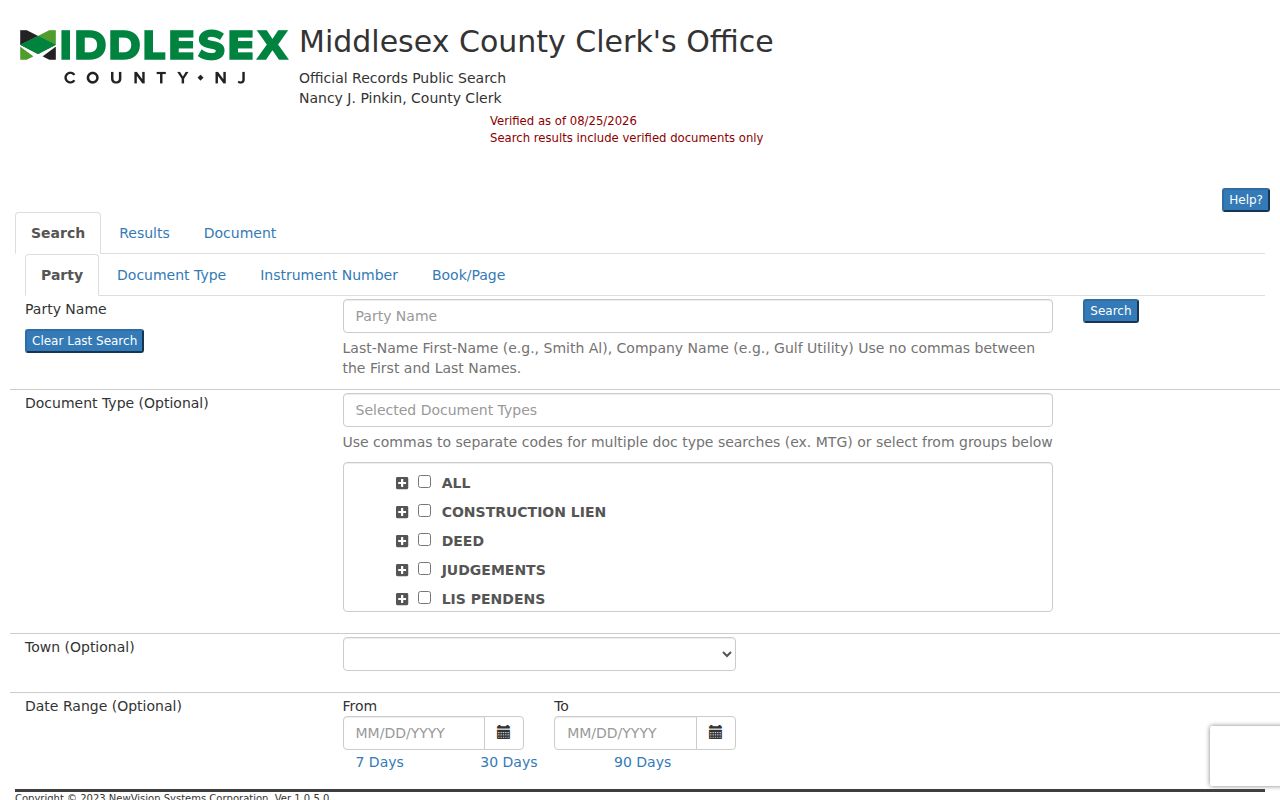
The browser offers several routes to one instrument, which is useful when an older deed carries an abbreviated name, a lot and block, or a prior book-page citation. Retain the instrument type, recording date, parties, and legal description when the detail is available. If only an index row appears, the Registry Division provides counter and written-copy routes.
- Find the current Edison deed or index row using the parcel, town, lot and block, party, instrument, or book-page key that fits the record.
- Record the Edison grantee, the person or entity receiving the recorded interest, and the grantor, the party transferring it.
- Read the Recital or Being Clause in the deed. The County Clerk says it can name the seller and the prior deed book and page.
- Use that prior reference to find the preceding recorded transaction, then repeat the same process backward.
- Mark each Edison transfer as a deed-chain fact, not as proof that either party occupied the Edison address.
Note: A recorded grantee may be an owner without being a past resident, so preserve the evidence label with every name.
Edison Previous Residents Coverage Check
The Edison County Clerk's live search material states deeds from January 1, 1929, mortgages from January 1, 1950, and other documents from January 1, 1958. A 2022 county digitization announcement says public Edison deeds from the 1950s back to 1923 were digitized and viewable through Official Records. Those statements describe a real Edison coverage-date tension. Do not silently treat either one as a universal answer for every instrument type or every year from 1923 onward.
Test the exact instrument and year in the browser, then contact the Middlesex County Clerk Registry Division or use its public-records room, counter, or written-copy process if the item is not reachable online. The Registry FAQ says a certified deed copy can be requested in writing or in person for $2 per page plus a $10 certification fee. The office is the custodian for the copy, while an e-recording channel is restricted to authorized submitters and is not a public search route.
The older fallback is substantive. The State Archives reports Middlesex deed microfilm from 1784 through 1901 and deed indexes from 1784 through 1922. Those dates make it possible to continue a carefully cited chain beyond the modern browser, but not to assume that every image or index has the same online access.
Edison Previous Residents Under Earlier Names
Edison was Raritan Township until 1954. For a backward address search, use Raritan Township as well as the historic place labels that appear in the research: Menlo Park, Bonhamtown or Banhamton, Oak Tree, Stelton, Nixon, Clara Barton, North Edison, Pumptown, and other named sections only where a source uses them. A deed, directory, map, or clipping filed under an earlier label may be the correct record even though the current parcel is in Edison.
Historic name changes also affect street conclusions. A modern street number or parcel may not line up one-to-one with an earlier lot after a subdivision or merger. Keep the prior legal description and recorded book-page reference in the worksheet. The correct answer may be a documented relationship between parcels, not an unsupported statement that the address stayed unchanged.
Edison Previous Residents in Dated Snapshots
The State Library confirms Edison R.L. Polk directories for 1964, 1966, and 1968. They are dated Edison household leads, not continuous occupancy records. Earlier New Brunswick volumes can bridge an Edison Raritan Township question, but their scope must be read first: 1901 includes Bonhamtown, Metuchen, Raritan River Road, and Bound Brook; 1903 includes rural-delivery routes; 1940 includes parts of Raritan, North Brunswick, and Franklin; 1946 and 1954 include parts of Raritan Township; and 1962 and 1963 include parts of Edison and North Brunswick Townships.
Use the confirmed Edison city directory collections for the shelf and physical-access details, then pair a printed address or name with the appropriate census record. New Jersey state censuses run from 1855 to 1915. Federal schedules and state censuses can place a household in time, but historical jurisdiction and enumeration boundaries differ, so the address match must be checked rather than presumed.
- Write the directory year, title, stated scope, page, spelling, and exact address wording.
- Find the nearest suitable census year and compare the locality, household, and time period.
- Check the deed chain for a recorded transfer before or after the directory date.
- Use library clippings or township publications as dated context, then seek independent support for any address claim.
Edison Previous Residents and Probate
Edison probate can explain why a recorded interest changed hands. The Middlesex County Surrogate is the county route for wills, and the Registry FAQ lists its phone at 732-745-3055. State Archives reports county surrogate records from roughly 1785 to 1900 and surrogate books from about 1804. FamilySearch lists New Jersey, Middlesex County probate records as browse images for 1830 to 1921. These Edison sources can identify heirs, executors, and estate property language, but an estate role does not establish that a person lived at the address.
Consult the FamilySearch New Jersey and Middlesex collection listing before using its browse-images route.
Browse-image access does not guarantee that each probate file is indexed by name or that it contains a property address. Pair an estate reference with its deed, directory, or census evidence and describe the result as an heir, executor, or estate clue when that is all the record supports.
Edison Previous Residents and Property Alert
County Property Alert is useful only as voluntary monitoring for a registered party name and real-property legal description. Middlesex County says an alert usually arrives five to seven business days after recording. It can cover an unoccupied property, but it may not trigger if a fraudulent document lacks the registered name or legal description. It is not an index substitute and it cannot stop a legally recordable document.
Read the Middlesex County Property Alert explanation before deciding whether voluntary enrollment fits a property-monitoring need.
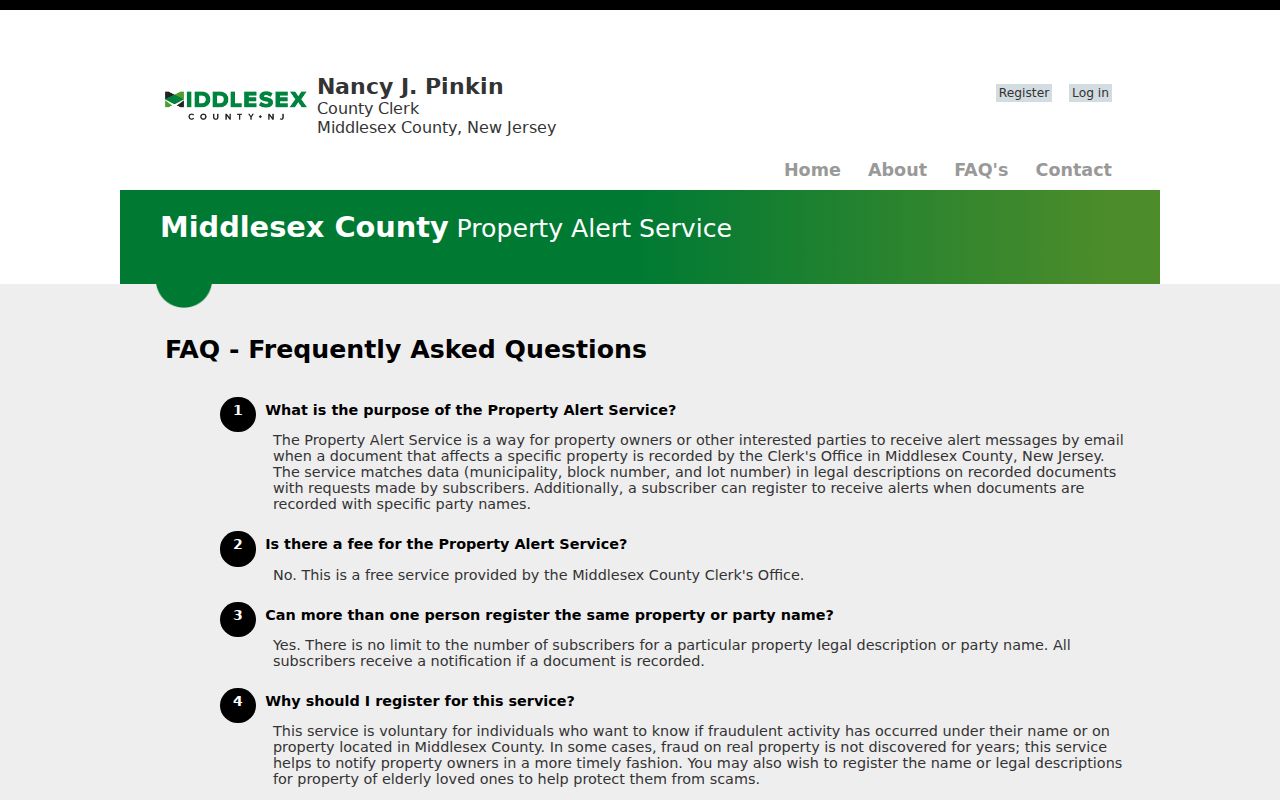
The alert information is separate from the deed-chain workflow. A previous-residents search still relies on the current parcel record, the Official Records browser or Registry copy route, and the older archive sources when the timeline requires them.
Labeling Edison Past Residents Carefully
The final Edison history should show the source path, not just a sequence of names. Use “assessed owner” for the current Edison tax record, “recorded grantor” or “recorded grantee” for a deed, “directory-listed household” for a printed volume, “household in a census” for the relevant schedule, and “estate party” for probate. That language protects the difference between ownership, mailing, occupancy, and family connection. It also makes a future correction much easier when a new document appears.
When a record remains uncertain, retain the negative result and move to the next custodian rather than filling the gap. The County Clerk, Edison assessor, State Library, State Archives, County Surrogate, and Edison library archive each keep a distinct part of the historical trail.