
Edison Resident Lookup Evidence
No official Edison database answers every question about one person. An Edison resident lookup starts with the record type, whether the question concerns a recorded property connection, a dated local appearance, a court matter, an individual voter-status check, or an eligible vital-record request. Middlesex County keeps the land-record trail, while Edison links its tax assessment search and keeps local vital events. The state Judiciary and election agencies operate separate systems. Treat every Edison result as evidence with a limited purpose, rather than as a complete profile.
| Record | What It Confirms | Where | Access |
|---|---|---|---|
| Edison tax assessment | Assessed owner, tax mailing, location, and parcel context | Edison Assessor and TaxDataHub | Official linked search, assessor, or a specific OPRA request |
| Edison recorded deed/index | Grantor, grantee, legal chain, and recorded instrument | Middlesex County Clerk Registry Division | Browser, counter, or written copy request |
| Edison parcel map | Block, lot, geometry, and mapped location | Edison map and county GIS | Map or REST query |
| Edison voter-status question | An individual's own registration confirmation | New Jersey Voter Search | Individual self-check only |
| Edison-related court case | Public docket or procedural status when returned | NJ Courts and Edison Municipal Court | Public route or court-record request |
| Edison vital event | Birth, marriage, or death event when eligibility is met | Edison registrar, NJ OVS, or Archives | Form, identity, relationship, and fee rules apply |
An Edison property search is often the best first check when an Edison address is known. A dated Edison library entry is better for a past association. Court and vital material have their own access limits. That split is why a resident lookup should record both the source and the evidence label before any conclusion is drawn.
Edison Resident Lookup Names
Begin an Edison name-normalization worksheet with the full name as known, middle initial, former or maiden name if relevant, spelling variants, likely municipality, known address, approximate date range, and any entity or trust name. The worksheet prevents a common surname from being silently collapsed into one person simply because Edison appears in a result.
Use explicit evidence labels as the records arrive: assessed owner, tax-mailing recipient, recorded grantee, court party, registrant self-check, or dated directory entry. An owner can be an entity or live elsewhere. A tax mailing address can differ from the property location. An entry in a historical directory is a dated publication lead, not proof of a current connection.
| Name form | Preserve middle initials, spacing, prior names, and likely spelling variants. |
|---|---|
| Place key | Keep the Edison address, block and lot, parcel ID, and date range separate. |
| Source date | Record the tax year, filing date, directory year, or retrieval date. |
| Evidence label | State what the record actually identifies instead of calling every match a resident. |
Note: A negative search can reflect a variant name, different jurisdiction, privacy protection, or an unindexed record rather than absence.
Edison Resident Lookup Crosschecks
The Edison-linked TaxDataHub search supports owner name, property location, block, lot, qualifier, and assessment or sales context. Record Edison district 1205, the parcel identifier, and the tax-year context. Then use the Middlesex County Official Records browser with the party name, town, lot/block, parcel ID, instrument number, or book and page. The county index and the assessment record serve different roles.
Follow this one-person verification sequence only when the proposed use is lawful and the details are relevant. It checks a recorded relationship to property, not physical presence at the location.
- Normalize the name and retain the exact Edison address or historical date range.
- Locate the property in TaxDataHub and write down the owner label, property location, block, lot, qualifier, parcel key, and tax year.
- Confirm the parcel in the Edison or county map layer, then search the County Clerk by the parcel or lot/block rather than by a loose street name.
- Read the deed details and preserve the recording date, parties, legal description, and any prior book/page reference.
- Compare the source dates and describe the result as an assessed owner or recorded grantee, never as an occupant without separate support.
A clerk index can lead to a deed image, but the image and a certified copy are not the same thing. The Registry FAQ states that a certified deed copy is available by written request or in person, with the listed copy and certification charges.
- Docket
- A court's identifying number for a case. It is stronger than a name alone because it ties results to one proceeding.
- Index and image
- An index lists searchable record details. An image is the underlying document or scanned page and may have different access rules.
- Certified copy
- A custodian-issued copy authenticated for the purpose the custodian permits. It is not created by a screen result.
Edison Resident Lookup Court Paths
NJ Courts Find a Case separates its databases by case type. An Edison court question may involve Civil or foreclosure party or docket searches, while Criminal uses name and county and criminal judgments can use defendant, SBI, complaint, or indictment numbers. Judgment liens accept party, judgment, or docket routes. Tax Court can use party, docket, or block and lot. Select the database that matches the Edison question before comparing a returned name with other evidence.
A case index is not identity proof. Check the court or county, docket, party role, filing date, event or disposition, document links, and any access warning. No live Edison case was inspected for the research, so no case subject or result should be invented. A name hit should remain a lead until it matches a separate, appropriate record.
The official NJ Courts Find a Case source shows the statewide routes used for an Edison resident lookup.
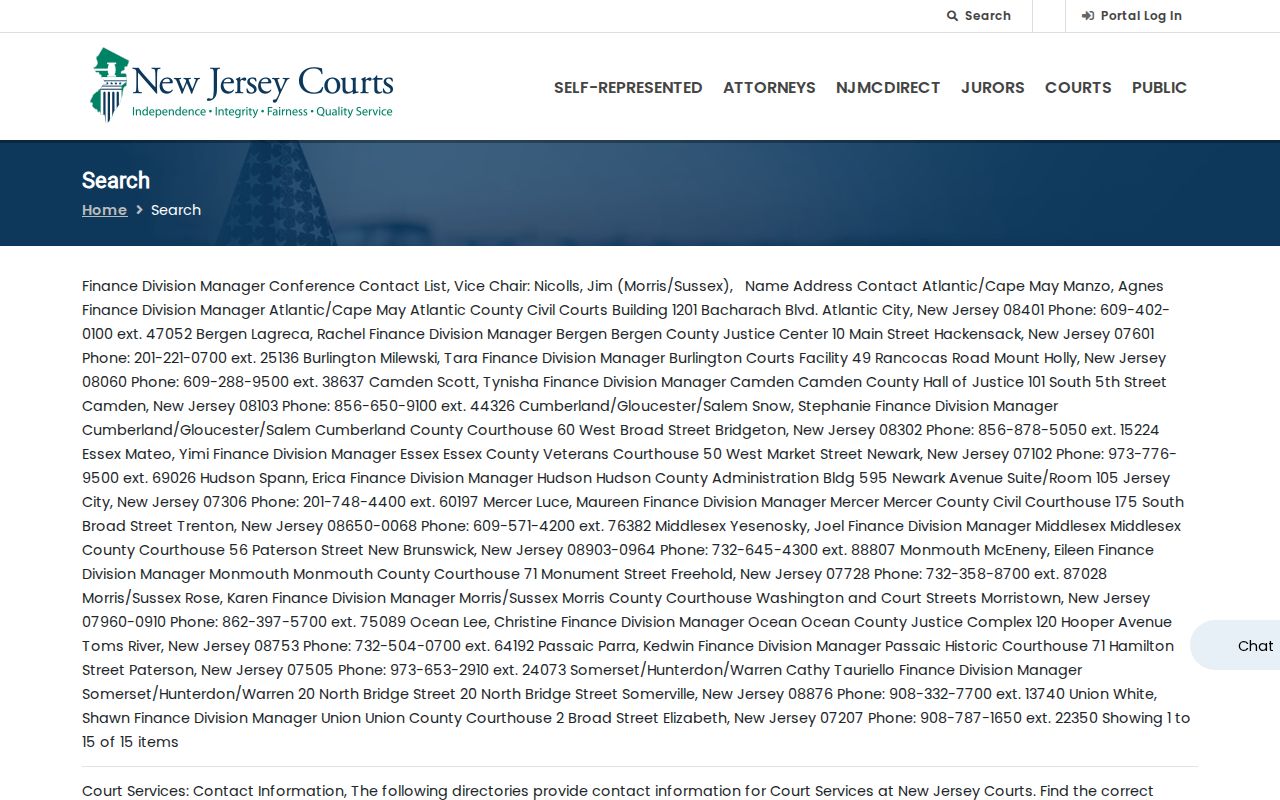
The court gateway makes the database choice visible, which helps keep civil, criminal, lien, and Tax Court results from being treated as one undifferentiated name search.
| Database selected | Record which court path was searched before relying on a result. |
|---|---|
| Search key | Keep the party, docket, complaint, indictment, judgment, or block/lot key used. |
| Case identifiers | Preserve court, county, docket, parties, filing date, and event or disposition. |
| Access status | Note document links and any warning instead of assuming an index includes the full file. |
Edison Court Ticket Limits
The Edison Township Municipal Court is a separate municipal route. Edison uses court code 1205. NJMCDirect is oriented to a ticket or complaint number, and the research did not establish a broad name-search option. Do not describe it as a general resident lookup or manufacture a ticket result when no valid number is known.
Use the ticket or complaint route only with that identifier. For a record-specific question, contact the court window. For eligible closed Civil, Special Civil, Criminal, Family, Municipal, or Tax Court material, use the Judiciary court-record request process. The request path differs from a police record and may have its own access rules. The Judiciary's Electronic Access Program is also a paid, limited system, not a substitute for checking a free public portal first.
Note: A municipal case entry identifies a case process, and it does not establish an Edison address or a person's identity by itself.
Edison Resident Lookup Voter Limits
New Jersey's Voter Search is an individual self-check. It lets an individual confirm that individual's registration status and correct information through the official election route. It is not an unrestricted Edison name directory, and the unattended research capture did not expose a reliable form-field list. No fields should be guessed from memory or reconstructed from the statewide administrative system.
For a specific Edison election-administration question, the Middlesex Board of Elections is the custodian path. The state system maintains more information than an individual public check should display, including protected identifiers and signature information. An Edison sample ballot, campaign notice, or published candidate name is not proof of a private address or current registration.
The official New Jersey Voter Search source is designed for the individual's own status confirmation.
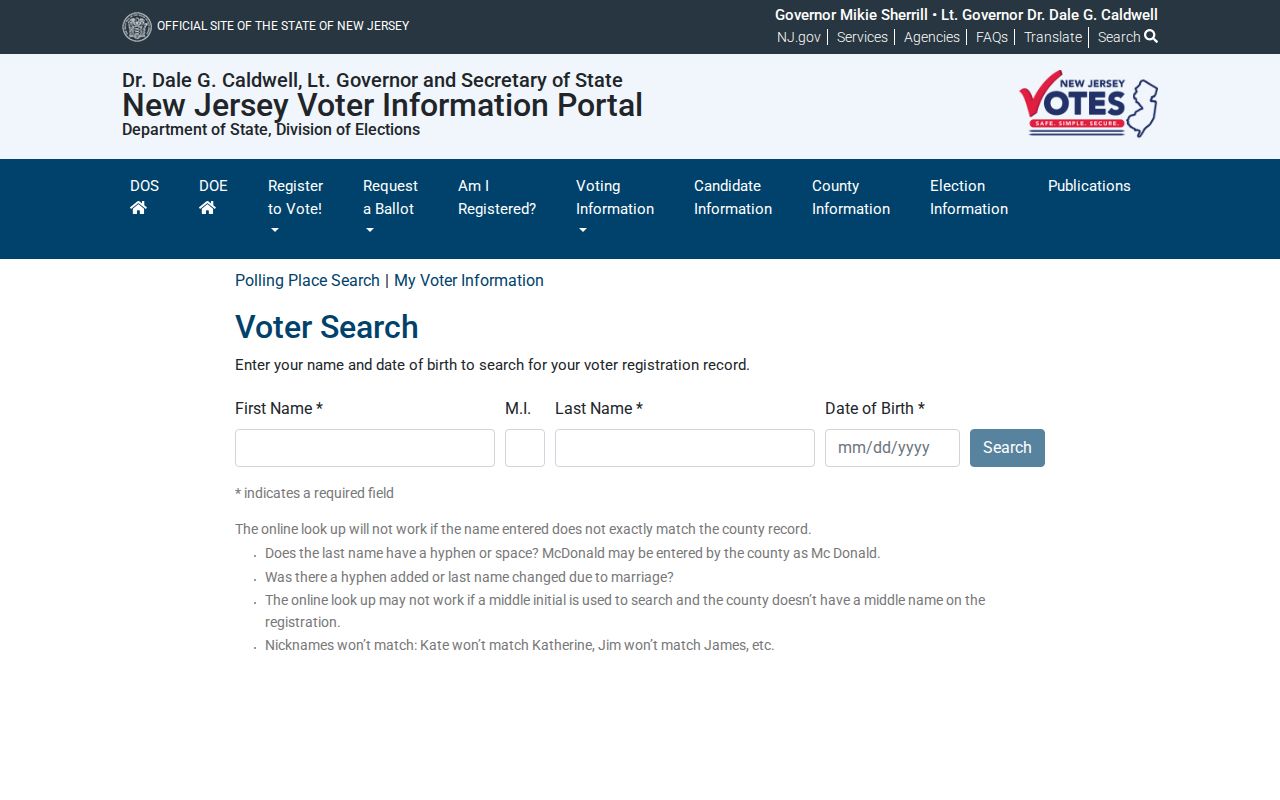
Use the state route for a personal confirmation, then direct record or correction questions to the responsible election office rather than building a list from it.
Edison Resident Lookup Vital Routes
The Edison Health Department Office of Vital Records keeps births, marriages, and deaths that occurred in Edison. Local vital-records instructions describe local copy and marriage-license procedures. The New Jersey Office of Vital Statistics and Registry controls statewide rules and ordering channels. Vital records are not public name-search directories, so an online search should not be used to bypass eligibility, identity, or relationship requirements.
New Jersey treats births less than 80 years old, marriages less than 50 years old, deaths less than 40 years old, and all domestic partnerships and civil unions as current records. Certified copies require a qualifying relationship or other eligible basis. For family-history work, use the state genealogy route and the State Archives date boundaries: state births begin in 1925, marriages and deaths in 1951, with earlier material in archival holdings. Edison events need the event municipality, name, date, and the proper registrar channel.
The Edison vital-records source shows the local request route.
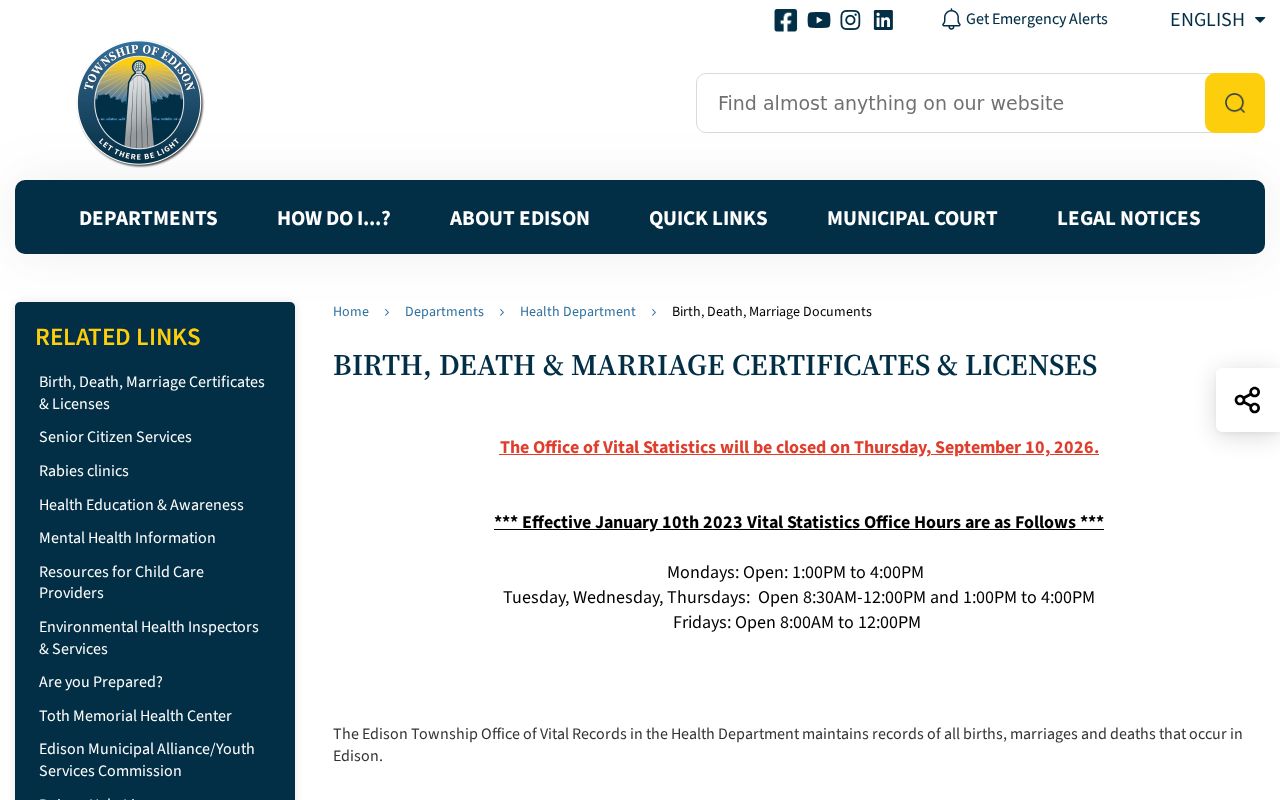
Local instructions are useful for an Edison event, while a certificate remains subject to the state and local eligibility rules that apply at the time of the request.
Edison Resident Lookup Archive Fallbacks
When the Edison question is historical, the Edison Public Library digital archive offers newspapers, clippings, photographs, meeting minutes, newsletters, and township publications. Those Edison collections include clippings from 1957 to 1979, Limelight newsletters from 1987 to 2005, and meeting minutes from 1973 to 2017. A notice, obituary, photo caption, or organization item can support a dated local connection when its collection and date are retained.
The New Jersey State Library lists Edison directory holdings for 1964, 1966, and 1968, while New Brunswick and Raritan Township volumes can help with older geography. Record the exact volume scope, page, and year. For a municipal record not already published, use a narrow request under the New Jersey Open Public Records Act, N.J.S.A. 47:1A-1 et seq. Identify the record series, department, address or block/lot, and date range. OPRA is a fallback for a specific record, not a request to create a name list.
Edison Resident Lookup Privacy
Privacy protections can explain a missing or reduced Edison result. The New Jersey Address Confidentiality Program provides a substitute address for qualifying participants. Daniel's Law and the Office of Information Privacy protect eligible people and immediate household members by shielding home addresses and unpublished phone numbers on government sources. Do not try to defeat an Edison substitute address or redaction by combining records.
OPRA also requires redaction of protected data such as Social Security numbers, credit-card numbers, unlisted telephone numbers, and driver-license information. Motor-vehicle personal information is restricted under the Driver's Privacy Protection Act guidance. Ask the custodian for the segregable public portion of a specific record, preserve its citation, and leave protected identifiers out of notes. A commercial recompiled-data category can be stale or merge people incorrectly, so the official custodian remains the better source for verification.
Lawful use. Use Edison resident lookup records for lawful personal research, family history, civic transparency, estate questions, or property verification. New Jersey's anti-stalking and harassment laws prohibit using information to stalk, harass, threaten, or intimidate anyone.